Bioanalytical Chemistry & Aerosol Research
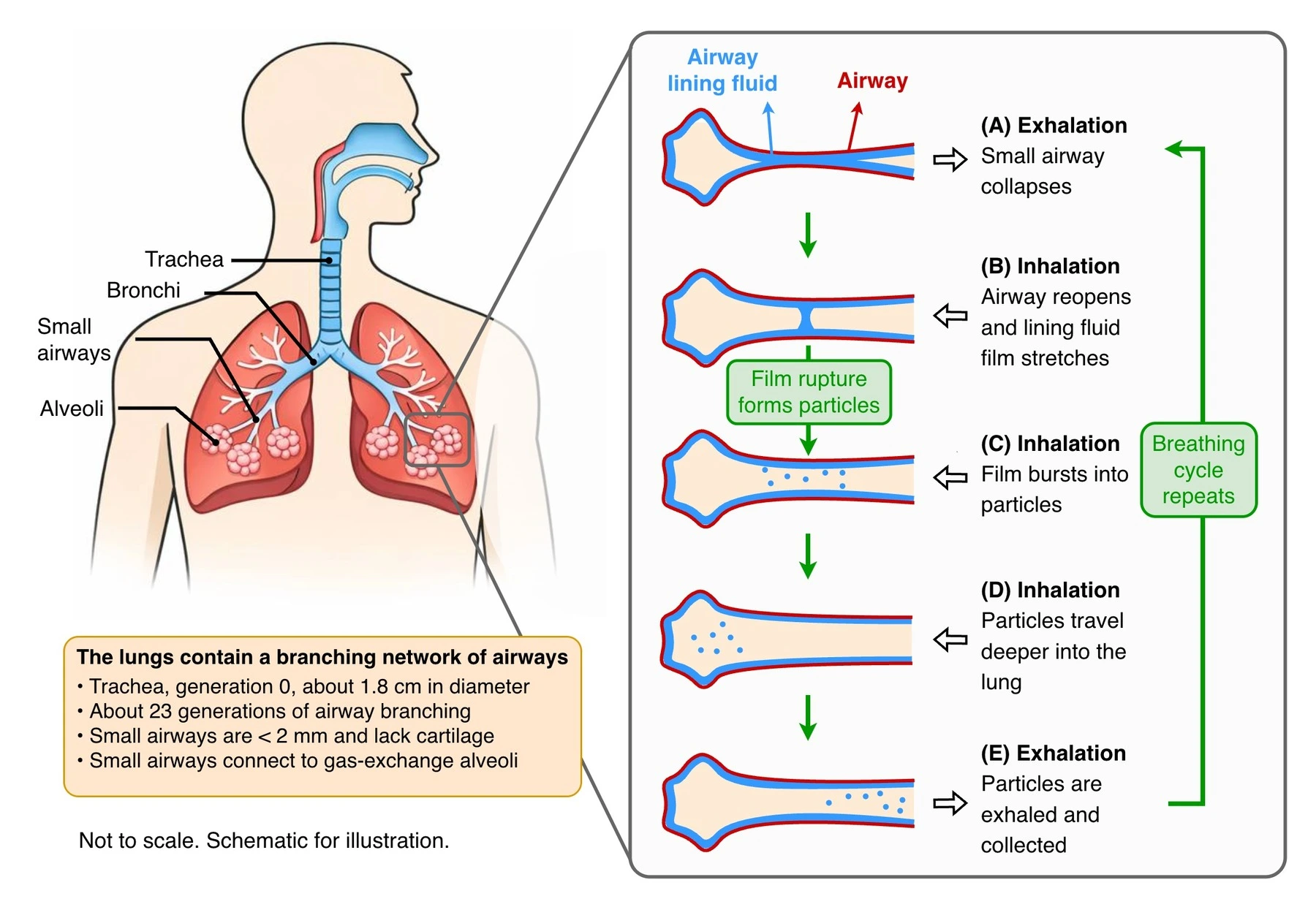
Text description of the airway diagram
The schematic labels the trachea, bronchi, small airways and alveoli. The trachea (generation 0) is about 1.8 cm in diameter. The lungs have about 23 generations of airway branching. Small airways are less than 2 mm across, lack cartilage, and connect to gas-exchange alveoli. The drawing is not to scale.
- Exhalation: a small airway collapses.
- Inhalation: the airway reopens and the airway lining fluid stretches into a film.
- Continued inhalation: the film ruptures, forming fluid particles.
- Particles travel deeper into the lung during inhalation.
- On exhalation, particles leave the lung and can be collected. The breathing cycle repeats.
Arrows show the sequence. Blue identifies airway lining fluid and particles; red outlines the airway. The labels and sequence carry the same information without relying on color.
Our research focuses on developing quantitative analytical technologies to study biological systems and understand the biochemistry of disease. We aim to uncover mechanisms of disease and treatment response to enable diagnostic and therapeutic technologies that improve human health. One major area of interest is respiratory health, where we study lung biochemistry and disease transmission pathways to support the development of low-cost, noninvasive screening and monitoring platforms.
We use principles and tools of physical organic chemistry to develop sensitive and quantitative analytical methods. Our methods involve NMR spectroscopy and LC-MS for kinetic studies, structural analysis, and quantitation. We also use aerosol physics and fluid dynamics to build instrumentation that enables these studies. Through additive manufacturing and electronic automation, we build reliable devices for use in clinical and environmental studies.